Implementing Actionable KPIs for Garment Factory Management and Production Staff
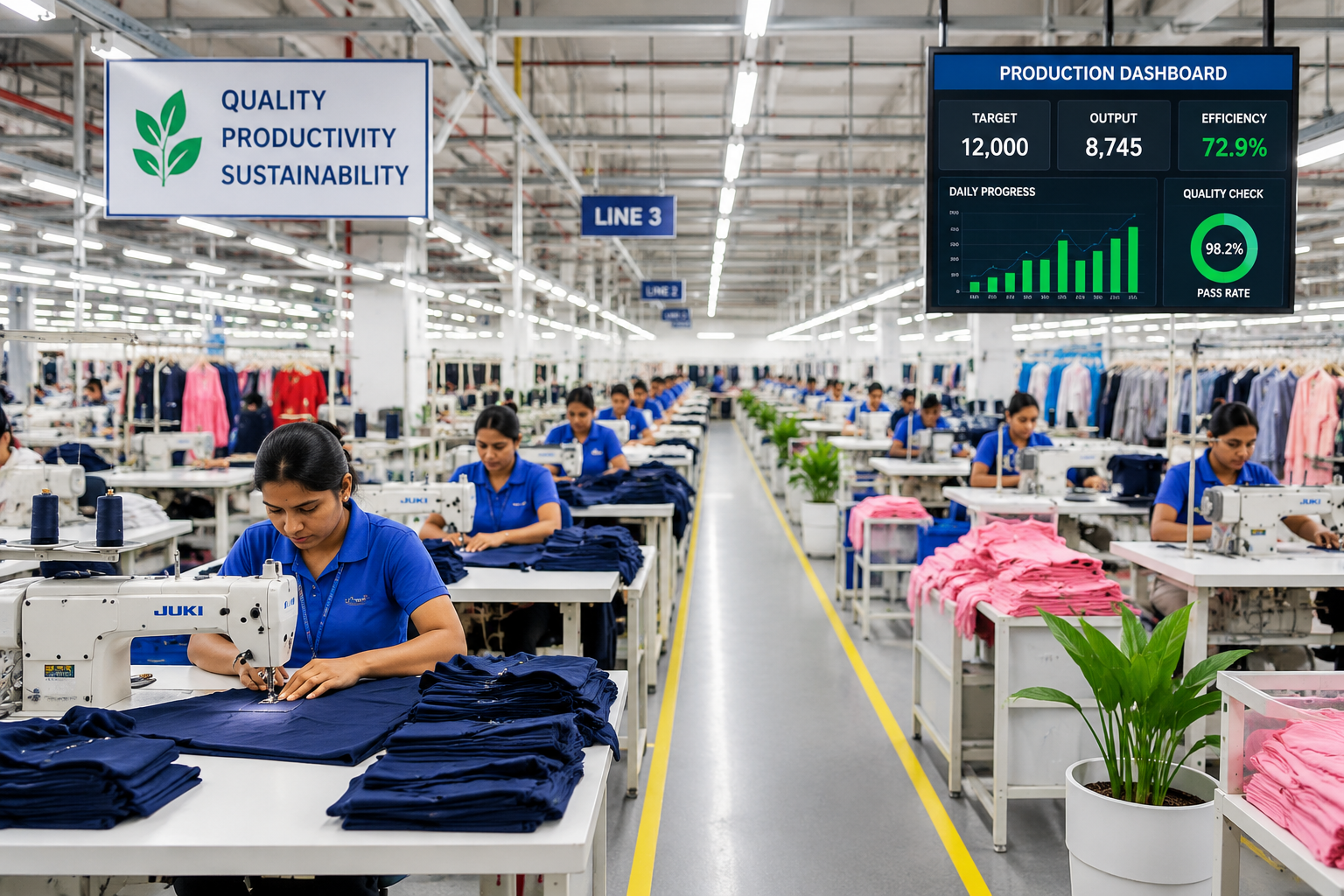
Managing productivity in the garments industry requires a delicate balance between speed, quality, and workforce morale. To achieve peak efficiency, factories must move away from generic performance metrics and implement highly specific Key Performance Indicators (KPIs) tailored separately for production workers and management teams.
For the production line, tracking metrics like Individual Efficiency (Output vs. Standard Allowed Minutes), Defect Rate, and Attendance is foundational.

However, the management team requires entirely different benchmarks. Factory managers, line supervisors, and floor leaders should be evaluated on overall Line Balancing Efficiency, Order-to-Shipment Lead Time, and Skill Matrix Development (how well they upskill and cross-train their operators to handle different machine types).
By


Managing productivity in the garments industry requires a delicate balance between speed, quality, and workforce morale. To achieve peak efficiency, factories must move away from generic performance metrics and implement highly specific Key Performance Indicators (KPIs) tailored separately for production workers and management teams.
For the production line, tracking metrics like Individual Efficiency (Output vs. Standard Allowed Minutes), Defect Rate, and Attendance is foundational. When an operator knows exactly how many pieces are expected per hour to hit their targets, it removes ambiguity and builds a self-driven environment.
However, the management team requires entirely different benchmarks. Factory managers, line supervisors, and floor leaders should be evaluated on overall Line Balancing Efficiency, Order-to-Shipment Lead Time, and Skill Matrix Development (how well they upskill and cross-train their operators to handle different machine types).
By implementing a centralized performance dashboard—ideally managed via streamlined tools like Microsoft Excel or integrated MySQL databases—HR and Operations can pinpoint exact production bottlenecks in real-time. When workers and supervisors clearly understand how their daily output connects to performance bonuses, factory floor retention increases, and costly production delays drop significantly. Structured data metrics turn guesswork into predictable, profitable manufacturing.
Discussion (0)
Be the first to share your thoughts on this strategy.
DEBUG URL: https://www.youtube.com/embed/LRs6KikVUlo